Friday, March 4, 2016

Saturday Morning Films - Mar 5

Saturday Morning Films features educational film reels of the past for you to wake up to, on your Saturday morning. Typically there is a combined running length of roughly one hour and usually focus on a single broad topic.

This Saturday: Plastics


Synthetic Fibers - 1949
Archive.org - Synthetic Fibers: Reveals how modern science and technology have made possible the development of new artificial fibers for making textiles -- specifically rayon and nylon. Portrays some of the processes used in making these fibers, ways in which they are useful to man and characteristic of the textiles made from them. - Encyclopedia Britannica Films

Origin & Synthesis of Plastics Materials - 1945
Archive.org - Origin And Synthetis of Plastics Materials: Shows the organic origins of plastics and natural substances; synthesis of plastics from natural substances; differences between thermosetting and thermoplastic materials; compounding platics to provide desired properties in products forms in which plastics are produced and typical plastics products.- U.S. Office of Education

Kingdom of Plastics - 1945
Archive.org - The Kingdom of Plastics: This early Technicolor presentation, sponsored by General Electric, opens with a group of children playing blindman's bluff. Little Susie is stumped because the object she's trying to guess is not from the animal, vegetable or mineral kindoms, but her dad (an engineer) soon sets her straight. It's from the "fourth kingdom," he explains -- the kingdom of plastics. After reviewing the role of thermoplastic and thermosetting compounds in history and World War II, this film ends on a note of postwar positivism, as the narrator speculates about plastic fabrics, shoes-of-the-future, and other man-made wonders of the world of tomorrow. - General Electric / Handy (Jam) Organization

Plastics - 1944
Archive.org - Plastics: Surveys the growth of the plastic industry, stressing the new materials developed during World War II. Shows the manufacture and fabrication of articles from plastic materials. - Young America Films


LAMO 40


LAMO image 40 has been released to the JPL Photojournal.

LAMO 40 features the southern portion of Ikapati crater. An interesting hummocky surface is present within a feature in the lower left of the image, somewhat reminiscent of areas of Charon, the major moon of Pluto. Much of the terrain in the imaged region reflects strongly in the blue spectrum and is quite smooth overall, suggesting the area was recently impacted, casting ejected material across the landscape.

LAMO 40 - PIA20394
Imaging Map (2016-03-04)

Thursday, March 3, 2016

LAMO 39


LAMO image 39 has been released to the JPL Photojournal.

LAMO 39 features the western rim and interior basin of Ikapati crater. The central peak of the crater is very prominent and broad in coverage. Several fractures are also scattered on the northern and eastern portions of the crater, possibly a result of the crater rapidly cooling shortly after impact. The entire northern portion of the crater appears to have collapsed inward, toward the central peak. Looking at the topographic map reveals that the area directly north of the crater, is much higher in elevation than the surrounding areas, likely making the original northern rim quite high and unstable with the soft soil. The crater floor is overall very smooth. The color map shows Ikapati crater to be very reflective in blue wavelengths, suggesting the crater is likely the result of a recent impact.

As noted in the Photojournal entry, the imaged region is centered at approximately 45 degrees north longitude, 50 degrees east latitude.

LAMO 39 - PIA20393
Imaging Map (2016-03-03)

LAMO 38


LAMO image 38 has been released to the JPL Photojournal.

LAMO 38 features the northwestern rim and interior basin of Azacca crater near the Cerian equater, in the Occator quadrangle. A large system of fractures is present across the eastern portion of the interior basin. These fractures are possibly due to the rapid cooling of the surface shortly after the impact. The rim of Azacca exhibits a great deal of mass wasting, leading to the terraced appearance. Much of the crater floor also appears rather smooth. In the color map, Azacca crater also has a strong blue signature, further suggesting it is likely a result of a recent impact.

As noted in the Photojournal entry, the imaged region is centered at approximately 5.3 degrees south latitude, 217.4 degrees east longitude.

LAMO 38 - PIA20392
Imaging Map (2016-03-02)

Tuesday, March 1, 2016

LAMO 37


LAMO image 37 has been released to the JPL Photojournal.

LAMO 37 features the southwestern portion of Sintana crater in the southern hemisphere. The imaged region appears mostly saturated with impacts, suggesting much of the terrain is very ancient. In contrast, the small crater on the rim of Sintana, appears quite recent and reflects a very strong blue signature on the color map. Ejected material from this small crater has been blown into the interior basin of Sintana crater. A nearby landslide event also appears next to the crater, possibly a result of the nearby impact shaking the soil. As noted in the Photojournal entry, the imaged region is centered at approximately 51 degrees south latitude, 46.1 degrees east longitude.

LAMO 37 - PIA20391
Imaging Map (2016-03-01)

LAMO 36


LAMO image 36 has been released to the JPL Photojournal.

LAMO 36 prominently features Sekhet crater in far southern hemisphere, near the south Cerian pole. A high amount of mass-wasting has occurred within Sekhet crater, completely obscuring the crater floor. Numerous minor impacts dot the terrain and a second large impact is present in the upper left of the region. Surrounding this smaller crater is much smoother terrain which is likely a result of the impact and the ejected material from the location of crater. Very large boulders can also be spotted surrounding the crater, some as large as 300 meters across. When looking at the color map, this smaller crater only has a very minor signiture, barely coloring the surrounding area with a slight green tint. This is most due to the low resolution of the available color map at this time. As noted in the Photojournal entry, the imaged region is centered at approximately 67.3 degrees south latitude, 251.5 degrees east longitude.

LAMO 36 - PIA20390
Imaging Map (2016-02-29)

Sunday, February 28, 2016

Juling and Fluusa craters, an Oblique Mosaic

 
Juling and Fluusa craters, an Oblique Mosaic

LAMO 32 - LAMO 33

Weekly Read & Watch List - Week of Feb 28


Week of February 28, 2016

This section is a curated list of articles, white papers, concepts, events, videos, and data releases. Some listed items may not be current but are nonetheless quite interesting.

Articles & Sites of Interest

Concepts & White Papers

Events & Involvement

Videos

Data


Activities

Spacecraft Updates
  • Feb 28: Juno - 799,917,000 km from Sol, 69,939,000 km to Jupiter @ 26,044-km/h
  • Feb 28: New Horizons - 5,206,153,000 km from Sol, 286,555,000 km from Pluto, 1,281,132,000 km to KBO-JimGreene @ 51,998-km/h
  • Feb 28: Voyager 1 - 20,070,061,000 km from Sol @ 61,233-km/h
  • Feb 28: Voyager 2 - 16,530,316,000 km from Sol @ 55,419-km/h

Blog Entries

Saturday, February 27, 2016

LAMO 35


LAMO image 35 has been released to the JPL Photojournal.

LAMO 35 features an unnamed region east of Guaue crater, in the northern hemisphere. Much of the area is saturated with small impacts. The crater rim to the north appears to be quite old due to its heavily impacted and worn state. However, interestingly, the area appears to return a strong blue signature which would typically suggest a recent impact in the area. Such an impact is not present in this image. The source of the ejected, blue material is likely to be from nearby Guaue crater. As noted on the Photojournal entry, the imaged region is centered at approximately 30.8 degrees north latitude, 95.9 degrees east longitude.

LAMO 35 - PIA20389
Imaging Map (2016-02-26)

Saturday Morning Films - Feb 27

Saturday Morning Films feature approximately one hour worth of old film reel videos, sometimes with a theme, but often without.

This Saturday: 1964-65 New York Worlds Fair


World's Fair Report with Lowell Thomas - 1961

Unisphere: Biggest World on Earth - 1964

To The Fair - 1964

Thursday, February 25, 2016

LAMO 34


LAMO image 34 has been released to the JPL Photojournal.

LAMO 34 shares many features with LAMO 29 and others that are just to the northwest. Ejected material from a crater just out of the imaged region, on the right, appears to be draped over much of the lower portion of the imaged region, giving an overall, smooth appearance to the terrain. The visible crater on the right appears to be rather old, due to the presence of a high number of regionally large interior basin impacts, and the degree of mass-wasting around the rim.

LAMO 34 - PIA20388
Imaging Map (2016-02-25)
LAMO 29 / LAMO 34 comparison

Wednesday, February 24, 2016

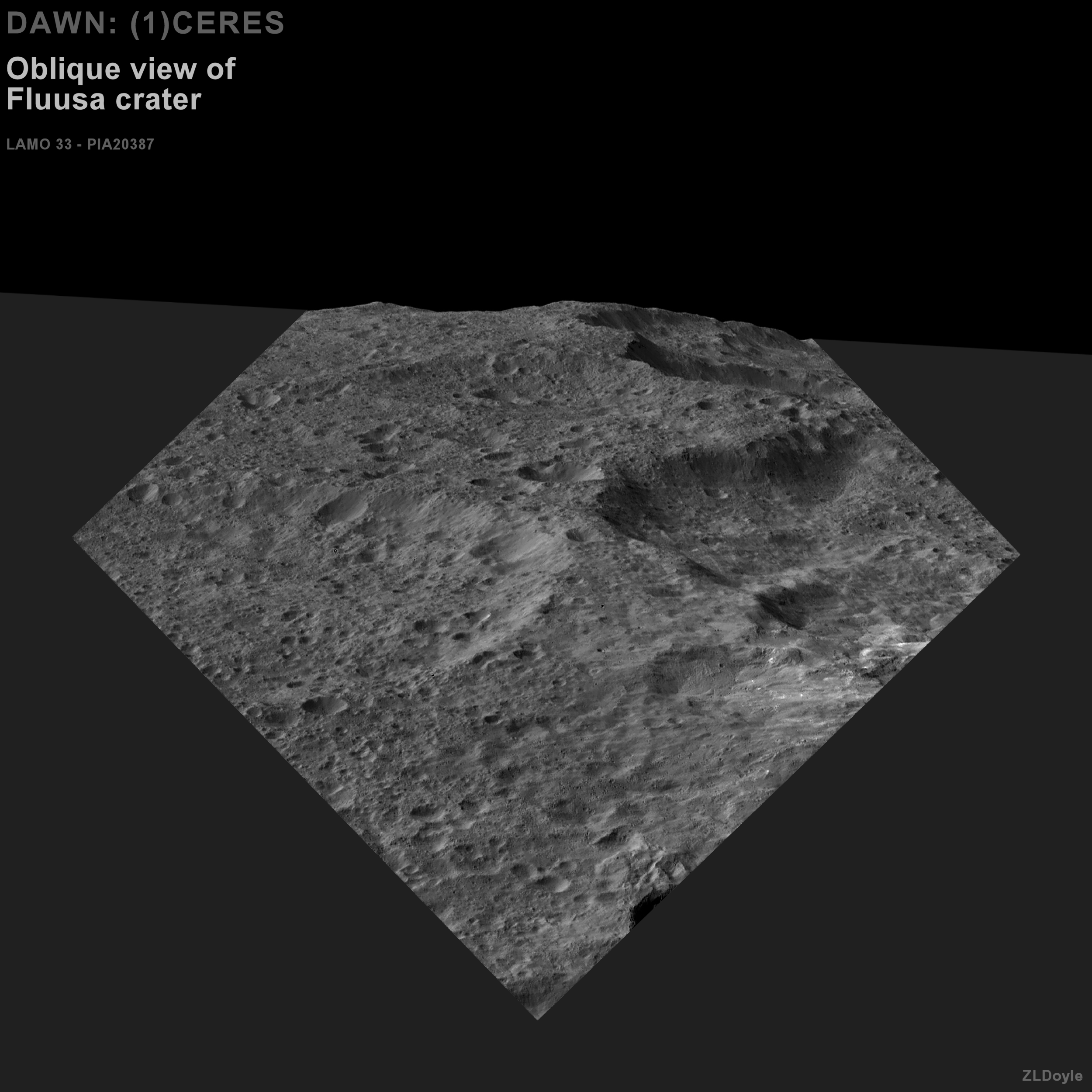
LAMO 33 - Reoriented


Here is an orientation corrected version of LAMO 33, as if you were looking obliquely across the surface from an orbiting platform. Fluusa crater is at the left most point.


Orientation Corrected LAMO 32

LAMO 33


LAMO image 33 has been released to the JPL Photojournal.

LAMO 33 is an extreme oblique view, looking over the craters Fluusa at top center and the northern expanse of Meanderi, in the bottom right. The landscape in the imaged region is heavily cratered to the point of saturation, and incredibly varied in altitude. The topographic map shows this region is be a portion of a long section of terrain which is highly varied in elevation, from the far southern hemisphere stretching northward above 40 degrees northern latitudes. Much of the imaged region is quite old. This is correlated with the color map, with exception to a portion of the ejecta blanket from Juling crater, which is located just outside of the imaged region on the left.

LAMO 33 - PIA20387
Imaging map (2016-02-24)

Updated 2016-02-25 - Fixed links to pictures. Sorry folks.

Juling Crater - H39-L32


Juling crater from HAMO 39 to LAMO 32

This is a synthetic animation, created from morphing HAMO image 39 to LAMO 32. This is done by placing a point cloud over each image, designating locations from one image to the other. 


Tuesday, February 23, 2016

LAMO 32 - Reoriented


Here is a orientation corrected version of LAMO 32, as if you were looking obliquely across the surface from an orbiting platform.


Orientation Corrected LAMO 32